Showing posts with label Christianity. Show all posts

Sunday, 7 December 2025

The Quiet Wealth of Being


How lucky we are when we learn to see what truly matters. Many of us measure life by labels and momentary pleasures: the right coat, the perfect trip, a seat at an exclusive table. When those things are missing, the complaint is quick and loud. Yet another person—less loud, perhaps—gives thanks for a glass of water, a warm meal, the steady roof above their head, the touch of a friend who cares. These are not small things. They are the scaffolding of a life.

Happiness is relative because our lives are lived here on earth, in time and place, in bodies that need rest and breath. But there is a kind of absolute joy that reaches beyond condition and commodity—call it the Creator’s peace, call it God, call it the deep calm some people find inside. That deeper joy does not depend on fashion, account balances, or applause. It rests in a heart that notices and honors what is simple, true, and sustaining.

Imagine if we taught our eyes to seek beauty not in excess or harm, but in virtue and care. Imagine if the most admired qualities were not wealth and show, but honesty, wisdom, compassion, and humility. Think of how different our choices would be when the beautiful becomes the good. A face grown kind with age, the steady patience of a teacher, the righteous and peaceful governor, the soulful suffering of those who are in need, a landscape that takes our breath and quiets our rush etc.

The everyday gifts are easy to overlook. Water for drinking and washing, food to share, a street that is safe at night—these are miracles when we travel a little and see how many lack them. We are fortunate if our homes are not battlefields, if our days are not shaped by fear. When we live in such a place, gratitude can be a daily discipline. Gratitude trains us to notice, and noticing changes the heart. The small act of saying “thank you” softens the sharpness of complaint and opens us to wonder.

Gratitude becomes courage when it leads us to act. To feel blessed and do nothing is a kind of theft. If we treasure the quiet gifts of life, we owe it to others to widen those gifts’ reach. That work need not be grand to be real. It begins with small, steady acts: sharing what we can, listening when someone needs to speak, refusing gossip that wounds, voting for common good, teaching children to protect what is fragile. One generous hand can set an example; many gentle hands can change a town, a country, a world.

Unity is another kind of beauty. We do not all share the same ethnic group, language, or belief. That difference may frighten or divide us—but it also expands what is possible. When people of different backgrounds gather around shared ideals—fairness, learning, mercy, stewardship—we discover that distinction is not contradiction. It can be a bridge. A world that values the soul’s depth over surface sameness will find ways to listen, to build, and to forgive. This harmony may feel like an impossible dream, but every real change begins as someone’s choice to see beyond immediate comfort.

Our era tempts us toward quick satisfaction and hollow distinction. The lure of brands, the rush of always wanting more, the conversation that centers on what we do not have—these are powerful. Yet they are also fragile. Possessions decay; praise fades. Character quietly endures. To cultivate a life of meaning, we must practice seeing with different eyes. We must teach ourselves to find beauty in honesty, to praise restraint, to celebrate a spirit that seeks Truth over triumph. When beauty and goodness become inseparable, they guide our acts and shape our communities.

Change is a slow miracle. It does not require perfect people—only people willing to grow. Start where you are: choose gratitude this morning for a small thing, then another. Speak gently to someone who feels unseen. Protect what you can: a tree, a neighbor’s safety, a child’s chance to learn. Learn to listen before arguing. Let your work reflect care, not merely profit. These may seem like ordinary choices, but they add up. They teach others how to live.

If we all shifted our view, if we learned to admire virtuous hearts, to protect fragile beauties, to join hands across difference,then the world would not need grand slogans or impossible guarantees to become better. It would become better because ordinary people chose, repeatedly, to be kind, brave, and wise. That is how utopia begins: not as a finished plan, but as a thousand small decisions to value what lasts.

The quiet wealth of being is a house we can build, brick by patient brick. It asks for less show and more presence, less wanting and more giving, less fear and more trust. To change perspective is to change action. To change action is to change the world. If we truly want a life that matters, let us begin by noticing the gifts we already hold, and then using them to open the hands of others.

Sunday, 21 September 2025

The Hidden Heart of Our Earth


“Watch for the Day when the earth will be changed into a different earth and the heavens as well, and all will appear before Allah—the One, the Supreme.” (Qur’an 14:48)

“Then I saw a new heaven and a new earth. The former heaven and the former earth had passed away, and the sea was no more.” (Rv 21, 1)


The question of what lies beneath the Earth’s surface has involved our human imagination for millennia. Ancient traditions across cultures imagined subterranean realms inhabited by gods, spirits, or mythical civilisations. The Greeks and Romans spoke of Hades, Hindu cosmology described Patala, early Christians placed Hell beneath the ground, and Buddhism referred to Shamballa as a hidden inner world. These stories provided symbolic and moral frameworks, but they also shaped later speculations that attempted to explain the planet’s physical structure.

By the seventeenth century, such speculations began to take scientific form. As a matter of fact, the English astronomer Edmond Halley proposed in 1692 that Earth might consist of concentric hollow shells with luminous atmospheres inside. He even suggested that these inner spaces could account for phenomena like the Aurora Borealis. Although his hypothesis was quickly challenged, it inspired further discussion. Later, in the eighteenth century, experiments such as the Schiehallion project demonstrated that Earth’s mean density was far too high for a hollow model, confirming that the planet’s mass is concentrated in its interior. These early falsifications illustrate how science progresses: bold conjectures are welcomed, but they must withstand rigorous testing.

Despite being scientifically refuted, the Hollow Earth idea never disappeared. In the nineteenth century, figures like John Symmes revived it, arguing that vast inner worlds existed, accessible through openings at the poles. Symmes promoted his vision of a lush inner Earth to the public, gaining attention but little acceptance in the scientific community. Literature embraced the theme, however, with works such as Jules Verne’s Journey to the Center of the Earth and Edgar Rice Burroughs’ Pellucidar offering vivid adventures in imagined subterranean landscapes. Fiction allowed the idea to survive where science had moved on.

In modern times, Hollow Earth narratives appear in alternative science and metaphysical writings. The Italian astrophysicist and geophysicist Giuliana Conforto, for example, advances a highly original interpretation centered on the presence of a vast crystalline structure at the Earth’s core. According to her view, this crystal has a radius of approximately 1,200 kilometers and lies around 5,000 kilometers beneath our feet. It is not passive matter but a dynamic entity, exhibiting an unusual autonomy from known physical laws. Conforto suggests that this immense crystal is responsible for generating Earth’s magnetosphere, which she describes as shaped like an apple enveloping the planet. On the surface, its influence can allegedly be observed in phenomena such as the South Atlantic Anomaly, an area of weakened geomagnetic field that she interprets as a probable epicenter of an impending reversal of Earth’s magnetosphere—an event unprecedented in recorded human history. Rather than framing this as an apocalyptic catastrophe, Conforto interprets it as a “Revelation,” a call to reconsider our entire understanding of reality.

The crystal, in her description, does not emit light but sound. At its center lies an even smaller and denser “heart” with a radius of about 400 kilometers, rotating westward in the opposite direction of the larger crystal, which rotates eastward. Seismographic observations of earthquake wave propagation have revealed complex dynamics in Earth’s inner core, and Conforto interprets these as evidence of a dual rotation—both clockwise and counterclockwise—within the planetary heart. She sees this as a self-sustaining source of energy, a “prime mover” that requires neither combustion nor fuel. For her, this discovery is not just a matter of geophysics but a profound revelation: a demonstration that energy and time have no ultimate limits.

Conforto extends this principle of dual rotation beyond geophysics, suggesting that it is mirrored in the atomic and cellular structures of living beings. At this level, she proposes a link with the “weak nuclear force” of modern physics, specifically the phenomenon of the neutral weak current. While conventionally treated as one of the four fundamental forces of nature, Conforto interprets it as the “true light” mentioned in sacred texts—a form of energy that is not visible but can be sensed as consciousness, emotion, and the unity of all life. This weak force, mediated by massive Z bosons, is in her view not weak at all but a transformative and accelerating energy. It could, she suggests, influence organic molecules, expand life, overcome fear, and foster communion between beings.

In this framework, the “true sun” is not the star in the sky but the great crystal at Earth’s center. Every crystal, she notes, emits sound quanta known as phonons, and this immense inner crystal produces what she describes as a “great opera,” a cosmic music whose parameters—such as speed and inclination—are now shifting. This change, she argues, signals a transition from an old era dominated by fear, division, and the illusion of electromagnetic appearances, to a New Era characterised by expansion, unity, and a recognition of deeper truths. For Conforto, the growth of the weak field and the decline of the electromagnetic field are emblematic of this epochal shift.

While Conforto’s ideas diverge sharply from mainstream science, they highlight the symbolic power of Hollow Earth narratives to capture questions that transcend physical geology. They address not only what lies at the center of the planet, but also what energises life, how consciousness interacts with matter, and how humanity interprets change on a planetary scale.

However, according to mainstream geophysics, there is another antithetical explanation of Earth’s structure. Seismology reveals a solid inner core, a liquid outer core, and a mantle of dense rock above them. Earth’s magnetic field is explained by the geodynamo: convective currents of molten iron in the outer core that generate magnetic fields consistent with both theoretical models and observational data. Satellite gravimetry, seismic tomography, and laboratory mineral physics all converge to support this layered model.

In conclusion, if we consider the vision of Giuliana Conforto and other scientists, philosophers, and  writers who imagine a kind of Hollow Earth with an inner sun, together with the possibility suggested by some authors that life might exist within it, then the connection with sacred scriptures becomes even more striking. Many traditions, from the Bible to the Qur’an, speak of a future transformation—a New Earth and New Heavens. If such hidden worlds or civilisations have always existed in harmony with Justice, Peace, and Love, their re-emergence could serve as a model for humanity. It would not only be a spiritual turning point, but also a transformation on many levels: physical, biological, chemical, geological, and even astronomical. In this sense, the Hollow Earth narrative can be read not just as a myth or a metaphor, but as a profound call to imagine a new epoch for humankind and for the planet itself.


References:

Giuliana Conforto, Il Sole nel cuore della Terra. https://www.giulianaconforto.it/post/1279

Katie Cutforth, “Hollow Earth Theory,” Mensa UK. https://mensa.org.uk/hollow-earth-theory/

Joel Frohlich, “How the Hollow Earth hypothesis illuminates falsifiable science,” Aeon. https://aeon.co/essays/how-the-hollow-earth-hypothesis-illuminates-falsifiable-science


Monday, 7 July 2025

VIEWS ON HUMAN PASSIONS IN GRECO-ROMAN PHILOSOPHY


In every culture and philosophy, there seems to be a common agreement, that is to say that virtues are to be pursued and vices avoided. The former, like courage, compassion, temperance, and wisdom, are celebrated as ideals that elevate the human soul and spirit. On the other hand, the latter, such as greed, envy, wrath, and sloth, are seen as moral failings that corrupt our character, our spiritual parts and our relationships with others. This double classification often gives us a clear direction in life—to strive for the good and renounce the bad. However, what about our passions? Where do they fit in this moral framework?

Passions are intense emotions or drives that move us deeply. They can be joyful or sorrowful, uplifting or destructive. Unlike virtues and vices, which are more moral categories, passions are psychological and emotional forces that may affect our actions. The question then arises as to whether negative passions, like anger, fear, sorrow etc, are inherently dangerous and whether we should aim to weed them out, simply control them, or find a balance, a middle way.

Consider anger, for example. Left unchecked, it may lead to violence, hatred, and division. But when tempered and guided by reason, anger may serve a moral purpose. A parent who feels righteous anger may discipline their child not out of malice but out of love and a desire to teach right from wrong. Similarly, societal outrage against injustice has often been the spark for reform and progress. Thus, even a passion as volatile as anger, when balanced and rightly directed, may be a force for good.

This idea reflects the ancient philosophical concept of the "golden mean" (aurea mediocritas), particularly emphasised in Aristotle’s ethics. According to the Greek philosopher, virtue lies in the balance between extremes. Courage, for instance, is the balance between cowardice and recklessness. Likewise, managing passions involves neither suppressing them completely nor indulging in them recklessly, but finding the right measure in each context. Passions may not be enemies of virtue, but allies if understood and harnessed wisely.

However, not all philosophers agreed. The Stoics, for example, tended to believe in a more radical approach to the passions. For most of them, passions (pathĂȘ) were irrational and harmful, stemming from false judgments and mistaken values. They advocated for apathĂ©ia (from the Ancient Greek a-, "without," and pathos, "passion"), a state not of apathy in the modern sense, but of equanimity and freedom from disturbance. The sage, in Stoic philosophy, is one who has eradicated irrational emotions and lives according to reason alone. In this view, passions are not to be balanced but overcome entirely.

According to Chrysippus, a thinker pf the Early Stoa, the passions are evaluative errors, wrong opinions about what is good or bad. For instance, fear is an irrational aversion to something anticipated as harmful, while lust is an irrational desire for something mistakenly seen as good. These passions disrupt the harmony of the soul and cloud judgment. The Stoic concept, therefore, is not to feel less, but to feel rightly: not to be cold or unfeeling, but to experience eupatheia (from the Ancient Greek eu-, "good/well"), the rational, measured emotions such as joy (chara), wish (boulesis), and caution (eulabeia). These are lucid emotional states appropriate to the wise person who sees the world rightly.

Moreover, Seneca, a Roman Stoic, strongly argued that dangerous passions, like anger and hatred, should not simply be moderated, but extinguished. To those who claimed that courage required anger, he responded that reason alone is sufficient to motivate moral action, and that once reason is touched by passion, it loses its clarity. Philosophy, in this view, is medicine for our soul, teaching us to distinguish good from evil and to preserve inner peace.

Yet even within ancient thought, there were alternative views. Plutarch, though admiring Stoicism, believed that all passions could carry something useful. Like music, he argued, where harmony comes from a balanced mixture of high and low tones, the soul too may achieve virtue through the right combination and calibration of passions. Anger, if properly measured, may assist courage, and hatred of evil may fuel justice. The key lies not in the eradication of emotion, but in its attunement.

The Epicureans, meanwhile, pursued a different path toward tranquility. Their concept of ataraxia refers to a state of serene calm, achieved not through suppressing all emotions, but by avoiding pain and fear, especially those arising from unnecessary desires and the turmoil of public life. For them, peace comes through simple pleasures and rational detachment from vain ambitions.

Therefore, it is evident that there is a range of philosophical attitudes: Aristotle's golden mean, the Stoic's apatheia, Plutarch's harmony, and Epicurean ataraxia. Each of them offers insight into how passions might be understood, cultivated, or transcended.

However, considering the spiritual dimension, one might ask whether Celestial Beings, who are often described as pure and radiant, experience these "negative" passions. In fact, as noted by those who claim to have encountered such Beings, it would seem that even these Spirits are not untouched by sorrow or concern. When these Celestial Beings are called to the mission of saving more and more human souls and observe the state of the world—our violence, greed, destruction, sins, nuclear weapons, pollution and so on—they are often described as sorrowful, disappointed, even upset. Their sorrow is not like human despair, though; it is a sadness born of Love, a deep longing for Harmony, Peace and Goodness.

Even the image of God, in various Scriptures, includes moments of righteous anger and divine sorrow. God is often depicted as a loving Parent who disciplines His children not out of cruelty but out of care and moral responsibility. Just as a good father might be angered by a child's misbehavior because he wants the best for them, the divine anger portrayed in religious texts can be understood as an expression of Justice and deep Concern.

This could suggest that being exposed to the human world, with all its imperfections and moral struggles, even Celestial Beings may begin to experience the dualities of our dimension. Their emotions, however, are not rooted in ego or desire but in Selfless Love and Divine Wisdom. It is a reflection of the Truth that emotion itself is not inherently flawed; it becomes distorted only when it is detached from Love, Reason, and Balance.

Yet, in the Heavenly Realms, in Paradise, where all things are in perfect Harmony, these "negative" passions seem to dissolve. In their place reign Joy, Peace, Gratitude, Love, Justice and Bliss—eternal and unshakable. These are the emotions that elevate the soul and the spirit and align them with the Divine Frequency. There, anger is no longer needed because Justice is fulfilled; sorrow vanishes because there is no more suffering; fear disappears because there is no danger. The higher emotions remain, when we have fulfilled our noble purposes, raising our frequencies and continually elevating our spiritual essence.

To conclude, passions are powerful forces in the human experience. While they can lead us astray, they can also guide us toward Truth and Virtue when rightly understood and moderated. Whether through the Stoic's rational mastery, the Aristotelian balance, and/or the spiritual transformation of the soul and of the spirit, humanity is called to integrate its emotional life wisely. Even Celestial Spirits, when they look upon and/or take part in our world, are moved by emotion—not because they are weak, but because they care, they love unconditionally and purely. They would love to save more and more human souls-spirits. So, one day, as we grow in Wisdom and Virtue, we too may ascend to a realm where Love reigns supreme, and all passions are transfigured into Eternal Light.

Monday, 2 June 2025

Toward True Freedom


In the face of such atrocities, which are still being carried out in various parts of the world, many would be driven by hatred, aggression, and violence when faced with such injustices. However, this would only play into the hands of the forces of evil, which are built on hatred, division, violence, destruction, and so on. They want us divided, blind, and ignorant, as the fault does not lie with populations, rather with those who actively take part in this evil plan!

It would be better to help and to speak out, to act without violence, and who knows, may God intervene in a drastic and decisive way! Then, we must rise above all that dehumanizes us, all that corrodes our souls and spirits. We think we are truly free when we enjoy things that have low vibrations — like vices, sins, harmful addictions, corruption, and so on — but in reality, we are more enslaved than we think.

True Freedom lies in going beyond the veil of Maya — that veil that clouds our senses, our reason, our heart, our soul, and our spirit — and in grasping the True Truth. The more we gain this higher awareness, the closer we come to this Truth, and the more we become truly free. We will be free to love unconditionally, in soul and spirit; we will be free to live beyond time, in Eternal Joy, in Harmony, Righteousness, and Peace. We will be free to access amazing realities that humanity has never known, and we will be free to love all that has been created.

After all, Creation is an act of Love. God is Love, and all His creatures are a reflection and symbol of this love — as is this Earth, which suffers so much because of human wickedness. So who knows how many souls will be able to make this leap, to reach higher levels of knowledge! But as long as human beings make war against their brothers and sisters in other parts of the world, how can we expect to travel beyond space, if humanity itself is a cancer to the Earth,  to its flora and fauna, and to the peoples who suffer from war, poverty, and more?


Saturday, 17 May 2025

Choosing Love, despite it all


In this world filled with desolation, constant wars, the looming threat of nuclear disaster, growing poverty, and endless rebellions — all signs of the evil that seems to keep dominating this Earth strongly— I often find myself reflecting deeply. I ask myself: why go on in a world like this? Why come to this place at all?

And yet, in this harsh school of life, I’ve tried to do my best. It has been through pain, through negative people, through darkness and destructive experiences, that I’ve learned and grown the most. Suffering has shaped me, like gold tested in fire, slowly refining who I am.

Still, there are moments when I feel like giving up. But then, something stirs within me. I look beyond the negativity, and I see that even through it, I’ve been growing. I turn my gaze toward God and His Celestial Hosts, and I remember that there is a deeper reason for being here. We are not here by accident. We are here to seek the Divine, to build meaningful connections, and to fulfill both individual and collective missions, even when those missions are hard to understand.

And then I remember a powerful truth: every femtosecond, every tiny instant of our lives, is precious. As Seneca once said, time is the most valuable thing we have. Within that fleeting time, I have the freedom to choose. And I do choose Love. I choose to Love freely, to give Love and receive It.

Every soul and spirit I encounter has the potential to become part of my journey, sometimes through pain, but also through joy and connection. Focusing on the positive, I realise that what truly keeps me going is the hope of meeting new, special souls. Even for a moment. Forever. To share a piece of my heart with theirs. To form a bond. To help them. To share my love, my peace, my wisdom and my knowledge. To become, all together, part of a Unique Big Universal Family.

This is what gives meaning to it all.

Sunday, 11 May 2025

The Sacred Line of Saint Michael the Archangel


Across Europe and the Mediterranean area, there is a mysterious and Sacred Path known as the Sacred Line of Saint Michael the Archangel. This line connects seven ancient sanctuaries dedicated to Saint Michael, the powerful Archangel who, according to the Bible, defeated satan in a great battle in Heaven (Rv 12:7–8).

What makes this line so fascinating is that all seven sanctuaries are perfectly aligned in a straight line. Even more amazingly, this line follows the direction of the sunset on the summer solstice. It is said that this is not just a coincidence, but a sign of Divine Order.

The journey begins in the far west, on the coast of Ireland, at the monastery of Skellig Michael. Built on a rocky island in the Atlantic Ocean, it is a place of deep silence and spiritual power.

The line continues to St Michael’s Mount in Cornwall, England. Like its twin in France, it rises from the sea and was once a place of pilgrimage for monks and knights.

Next comes the famous Mont Saint-Michel in Normandy, France, one of the most visited sacred places in the world. During low tide, pilgrims can walk to it across the sand, just as they did in the Middle Ages.

The line then crosses into Italy, where it reaches the Sacra di San Michele in Val di Susa, built high on a rocky mountain. This majestic monastery watches over the valley like a spiritual guardian.

Further south, still in Italy, lies the Sanctuary of Saint Michael the Archangel in Monte Sant’Angelo, on the Gargano Peninsula. This is one of the oldest places of worship dedicated to Saint Michael, known for its sacred cave where He appeared. This is the Celestial Basilica.

From Italy, the line stretches to Symi Island in Greece, where the Monastery of Panormitis stands. This beautiful white monastery faces the sea and is known for its miracles and devotion to Saint Michael.

Finally, the line ends in the Holy Land, at the Monastery of Stella Maris, on Mount Carmel, near Haifa, Israel. It is a peaceful and powerful place overlooking the Mediterranean.

Many people believe this line marks the path of Saint Michael’s sword, the one he used to cast satan into hell. For centuries, the line was honoured by pilgrims, saints, and the Knights Templar. Medieval Christians believed that walking this path brought them closer to God and protected them from evil.

Even today, the Sacred Line reminds us of the fight between Good and evil, Light and darkness. Saint Michael stands as a Heavenly Protector, ready to help us in times of trouble.

We end with the powerful prayer written by Pope Leo XIII, asking for Saint Michael’s Protection:


Latin:


Sancte Michael Archangele,
defende nos in proelio;
contra nequitiam et insidias diaboli esto praesidium.
Imperet illi Deus, supplices deprecamur:
tuque, Princeps militiae caelestis,
Satanam aliosque spiritus malignos,
qui ad perditionem animarum pervagantur in mundo,
divina virtute, in infernum detrude.
Amen.


English:


Saint Michael the Archangel, defend us in battle.
Be our protection against the malice and snares of the devil.
May God rebuke him, we humbly pray.
And do thou, O Prince of the Heavenly Host,
by the power of God, thrust into hell
Satan and all evil spirits
who wander through the world
for the ruin of souls.
Amen.


--------------------------------------------------------------------------


References

https://gcatholic.org/churches/list/St-Michael-Sacred-Line

https://gretour.com/st-michaels-line/

https://www.fisheaters.com/stmichaelsline.html

https://skelligislands.com/st-michael-line/

Wednesday, 7 May 2025

Let them speak ill, we elevate ourselves in Peace and Love


If the criticism is constructive, I welcome it: it can help me grow. But if it's meant to tear me down, I won't let it harm me. As long as I’m at peace with my conscience, and my choices don’t harm God, creation, others, or even myself, then what should I worry about?


People will always talk, no matter what you do, especially those who carry bitterness or malice in their hearts and in their minds. I pray for them. In my limited and imperfect life experience, I’ve noticed that most of the conflicts or judgment I’ve encountered have come from people in my own area rather than from Asia.


That’s not to say I’m idealising certain countries or imagining a perfect world there. The whole Earth is immersed in growing darkness. Still, I do notice a difference—perhaps in proportion, or perhaps because I’ve been blessed to meet kind and marvellous friends from various Asian countries.


From my flawed, earthly perspective, I’ve observed that many of my Asian friends, and other people from that part of the world, show a deep respect—for others, for life, for values. I sense their positive energy, their empathy, introspection, and emotional sensitivity. Many are weighed down by challenges of their own, and I pray for them too.


Sometimes, I sense that some of them may feel undervalued by others from the Western world. But I want to say this: every soul is unique and precious. No one should feel inferior. These people carry a rich heritage, a beautiful culture, and powerful inner qualities. If they channel these strengths into building a world rooted in Love, Peace, Justice, and Righteousness, they will shine eternally in the New Era of Peace (The Golden Age).


It's written:

“God has shown the strength of His arm;

He has scattered the proud in the thoughts of their hearts.

He has brought down rulers from their thrones,

and lifted up the humble.

He has filled the hungry with good things,

and sent the rich away empty.”


So to all my dear friends (especially the New Gentiles of Asia, who carry within them a deep spiritual elegance, quiet strength, and ancient wisdom) I say this: keep walking the path of Goodness. Not just in prayer, although prayer is powerful. But even more in action, in kindness offered with no reward, in virtues lived out day by day.


Share not only your resources, but your time, your presence, your compassion. Call a friend who’s struggling. Listen without judgment. Help someone find hope. Show patience when it’s hardest. Offer a warm smile to someone who feels invisible. Be honest, even when it costs you something. Defend what is right, even if your voice trembles. These are not small things, hey are seeds of Light.


As you begin to radiate these positive vibrations, you also begin to attract them (Law of Cause and Effect). And step by step, person by person, we become part of something far greater than ourselves: the building of a New World, a Kingdom of Love, Peace, Justice, and Truth.


And one day, when the veil is lifted, the reward will be beyond anything the human heart can fully imagine. Those who have loved deeply, unconditionally, who have served silently, who have sown good in hidden ways, these will shine like stars.


Because God sees all.


So do not grow weary. You are not alone. The good you do matters. And the Light you carry within you is stronger than the darkness outside.

Saturday, 3 May 2025

Unmasking evil and walking toward the Light


In our journey through life, we often see only the surface of things. However each human soul is called to look deeper. Behind every thought, word, and event, there is a hidden spiritual dimension. Our task is to learn how to unmask the evil that hides beneath appearances and to seek always what is true, good, and aligned with Divine Will, the Virtuous Path. This requires discipline, deep self-examination, and a firm desire to grow in holiness.

To unmask evil means to test every thought and action to see whether it comes from God or not. This is not easy. Evil often disguises itself as something harmless or even good. It may appear in the form of pride dressed as self-confidence, laziness disguised as serenity, or envy hidden under the name of justice. The devil does not always use violence or clear hatred; he often uses confusion, distraction, and lies. He attacks our minds with doubts and our hearts with temptations. That is why we must look into ourselves deeply and wisely. We must not let any thought or feeling pass without being tested. Is this idea leading me closer to God or away from Him? Does this action reflect God or the darkened world?

This work of constant examination is not to become proud or to think we can be like God, but to belong more fully to Him. We are not trying to replace Him but to reflect His Light. As human souls, we are called to strive for spiritual purity—not perfection in the worldly sense, but a heart that truly seeks God above all. We must learn to deny ourselves when our desires lead us away from holiness, and instead choose what is right, even when it is painful. This inner battle, this intransigence with ourselves, is how we polish our soul and our spirit to become more transparent on Heaven.

Besides, Saint Paul writes that our real enemies are not people of flesh and blood, but “the powers of this dark world and the spiritual forces of evil in the heavenly realms” (Ephesians 6:12). These demonic forces attack us physically, psychologically, and spiritually. They sow division in families, promote addiction and despair, and whisper lies into our hearts that we are worthless, alone, or beyond forgiveness. They want to block our spiritual evolution and keep us far from the Virtuous Path to Heaven. But we are not defenseless.

Saint Paul tells us to put on the full armor of God. This armor is spiritual and powerful. Truth is our belt—it keeps us upright. Justice is our breastplate—it protects our heart. The Gospel of Peace is our foundation—it guides our steps. Faith is our shield—it protects us from doubt and temptation. Salvation is our helmet—it guards our mind. And the Word of God is our sword—it fights lies with Divine Truth. Prayer is what keeps all this armor strong. We must pray at all times, not only for ourselves, but for all humans.

Therefore, Satan and his demonic forces do not simply seek to cause discomfort or temporary hardship; their true mission is total destruction—physical, psychological, and spiritual. These entities operate with subtlety and intelligence, often hiding behind what appears ordinary, pleasurable, or even harmless. Their ultimate aim is to prevent the soul from reaching union with the Divine, to stop our evolution toward Light, Truth, and Love. They do this by acting on all dimensions of human existence.

Physically, demons rarely intervene in direct, visible ways, but their influence can guide individuals toward choices that damage or destroy the body, which is itself a sacred vessel. They lead people into addictions—alcohol, drugs, excessive consumption of food, and other compulsions—because such behaviors weaken the will and dull the conscience. They encourage forms of extreme hedonism, seducing the body with pleasure to the point where it becomes enslaved to desire and unable to act freely. Sometimes they push toward the opposite extreme: self-neglect, a rejection of self-care that may arise from laziness, burnout, or even the belief that one's body is unworthy of love or attention. Violence is another powerful tool: demons stir up hatred and anger in hearts, which then spill into abuse, war, and cruelty. Domestic violence, murder, and physical conflict often have spiritual roots. Even distraction through constant comfort—passive entertainment, overindulgence in sensuality, or the obsession with superficial appearances—can serve their goals, as it lulls the soul into sleep and inactivity.

Psychologically, demons are especially cunning. The human mind, being the link between soul and body, is a central battlefield. Demonic forces are masters of suggestion. They plant lies in the form of intrusive thoughts: "You are worthless," "You will never change," "There is no hope for you." These thoughts often arrive in moments of fatigue or weakness and, if believed, take root in the heart. They inflate fear and anxiety, exaggerating risks and feeding paranoia, until a person becomes paralyzed and unable to trust life or God. Depression and despair are often exploited and/or caused by demonic presence, as demons capitalise on a person’s wounds, losses, and trauma to whisper: "There is no meaning, no redemption, no way out." They confuse identity, not just in terms of gender or role in society, but in a deeper spiritual sense—twisting one’s perception of self-worth, morality, and purpose. This confusion leaves people lost and vulnerable to manipulation.

Another common tactic is isolation. By sowing seeds of mistrust, suspicion, or even false independence, demons pull individuals away from families, friends, and spiritual communities. Isolation weakens us, because Love and Truth grow in relationship. Pride is often used as a mask: they convince us we don’t need anyone, that we’re better off alone, or that no one understands us. This creates spiritual blindness. Interestingly, demons use both extremes: they may inflate the ego until someone becomes arrogant, or crush it until one is stuck in deep self-hatred. Both are equally destructive. They destabilise the personality and block the person from finding interior peace and harmony.

But the most dangerous level is spiritual destruction, which is the very core of their mission. Here, the attack becomes existential. Demons tempt us to sin repeatedly, knowing that frequent sin dulls the conscience and forms habits. Over time, those habits become vices—chronic patterns that enslave the soul and create distance from the Divine. They use the illusion of harmlessness to justify evil: "It’s not that bad," or "Everyone does it." With time, this leads to spiritual numbness.

Another subtle tactic is spiritual pride. As someone begins to grow or practice their faith, demons may inflate the ego, making them feel superior to others. Instead of deepening in humility, the person begins to worship their own image of virtue. They may speak piously, but act without Love. Apathy and lukewarmness are perhaps the most quiet and effective demonic strategies. Many people do not reject God—they just delay prayer, ignore their conscience, or become too busy with distractions. Time slips away, and the soul slowly drifts into coldness without realizing it.

Doubt in God is often encouraged. Demons twist sacred teachings, suggesting that God is unjust, cruel, or distant. This intellectual confusion weakens faith. In some cases, they direct souls toward spiritual practices that are dangerous—forms of occultism, divination, or “light spirituality” that look harmless but are disconnected from Truth and lead toward false gods or energies. They may even offer a form of "false peace"—a calmness that comes from avoiding Truth and indulging in sin—which deceives the soul into thinking all is well, when in fact, it is asleep and vulnerable.

Finally, when someone begins to truly convert, to walk the Path of Light, that is often when the most brutal attacks come. Exhaustion, temptation, and discouragement increase. The demons know that spiritual rebirth threatens their control, so they try to strike the soul down with thoughts like: "It’s useless," "You haven’t changed," or "You’ll always fall back." They want the soul to give up just before it blossoms.

Yet, despite the depth of their attacks, these forces are not invincible. They are limited, and they flee in the presence of True Light, Love, and Humility. The Divine has given us all the tools to resist them. Recognizing their strategies is the first step in breaking their power. Through constant awareness, prayer, purification, and acts of selfless Love, the soul regains strength. Demons cannot stand in the presence of real holiness. Every small choice for Truth, every act of forgiveness, every effort to rise after falling, weakens their grip and brings the soul closer to its true destiny: union with the Divine.

And what about those who oppose us in the world? We must remember: every human is created by God and is capable of salvation. Even those who hate or hurt us are not our true enemies. We must pray for their conversion, not hate them. We must thank God for them, because they test our love and help us grow in patience and virtue. Every time we suffer for doing good, we are walking in the footsteps of God, and we are earning treasures in Heaven.

There is also a higher solution: the restoration of lost harmony between Heaven and Earth. This harmony—called kosmos in ancient Greek—was part of the original Beauty of Creation. We must return to it by building a relationship between the Celestial and the earthly, between Angels and human beings, between God and His human creatures. This is not imagination. It is possible through Love. Every prayer, every kind action, every small sacrifice filled with Love helps to bring this Harmony back. The more we act with sincere Love, the more we call upon Heaven to help Earth.

So how do we recognise and resist the demonic strategies meant to destroy us?

1. Distraction and noise: Evil uses constant noise—social media, gossip, shallow entertainment—to stop us from thinking deeply. We must create silence in our lives to hear God.

2. Fear and despair: Evil whispers that we are alone or doomed. But hope in God is stronger than any fear.

3. Pride and selfishness: Evil tells us to serve ourselves first. We must learn humility and serve others, as Jesus did.

4. Confusion and Relativism: Evil says there is no truth. We must stand on the Word of God, which is Eternal and Unchanging.

5. Temptation through Pleasure or Pain: Whether through comfort or suffering, the devil tries to weaken our will. We must stay close to God, with prayers, practice of Virtues and good deeds.

To grow spiritually, we must stay close to the Light — that is, to what is True, Good, and Just. This means being honest with ourselves, acknowledging our faults, and working daily to become better. It involves practicing Mindfulness, Compassion, Self-discipline, Altruism, and other Virtues, doing good deeds, staying connected to a community that shares our values, and acting with love toward all beings. Through prayer, meditation, reflection, practice of Virtues, acts of kindness, the more we choose Truth and Love, the less power negativity, hatred, and darkness have over our lives.

In the end, evil may be strong, but God is infinitely stronger. Light always defeats darkness. We are not alone in this fight. Angels fight beside us. Saints pray for us. And Christ walks ahead of us, showing the way. Our task is to keep going, always rising again, always choosing Love, always turning our face toward Heaven.


Tuesday, 29 April 2025

The dawn of a New Epoch: Joachim of Fiore's Three Ages, the Era of Peace, and echoes in Giordano Bruno


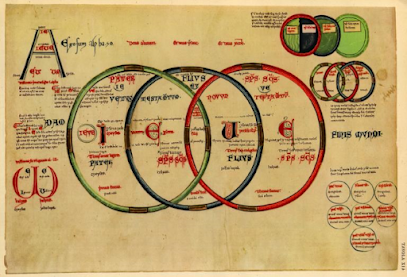
The concept of a "New Era" has captivated thinkers and theologians for centuries, with its roots deeply embedded in apocalyptic and millennialist thought. A pivotal figure in shaping Western perceptions of the future is Joachim of Fiore, a 12th-century Italian abbot whose theories profoundly influenced ideas of history, progress, and societal transformation. Moreover, some authors have analysed Joachim's framework of the Three Ages (status), with a particular focus on the anticipated Age of the Holy Spirit, and have explored how these themes resonate with the philosophy of Giordano Bruno, a Renaissance figure who envisioned his own kind of transformation.


Joachim of Fiore, the Three Ages and The Age of the Holy Spirit

Joachim of Fiore introduced a dynamic interpretation of history, diverging from the more static Augustinian view that dominated medieval thought. He proposed a model of the Three Ages (status), each linked to a person of the Holy Trinity, thereby providing a theological framework for historical evolution.

The first age, the Age of the Father, corresponded to the Old Testament, the Kingdom of Israel, and the reign of the flesh. This was a period characterised by a more materialistic and worldly existence. The second age, the Age of the Son, began with the incarnation of Christ and represented a period of struggle between flesh and spirit.

However, it would be the third age, the Age of the Holy Spirit, that would hold the promise of radical change and ultimate transformation of the world. This would be an era of spiritual renewal and purity, where the humankind would reject its worldly power, and the faithful would live directly under the guidance of the Holy Spirit. The age would be marked by Unity among all people, Christians, Jews and Muslims etc, who would come together. This age would be a time of Peace, Prosperity, and Harmony, fulfilling God’s Plan for Humanity. The Age of the Holy Spirit would be transformative, correcting the corruptions and injustices that had plagued our world.

Joachim envisioned the Age of the Holy Spirit as an era of profound transformation. He prophesied the rectification of society's corruption, with a return to the purity of Christ's teachings. The Universal Unity would be restored, and even other faiths would find Harmony within a Universal Spiritual Understanding. This new age would be characterised by genuine Peace and widespread Prosperity, lasting until the end of the world.

Central to this progress was the rise of "spiritual men," who would be active in the world, embodying Christ's teachings through service and compassion. Joachim foresaw new ascetic orders that would synthesise contemplation and action, driving the transformation of the world.

Furthermore, Joachim's vision included the unveiling of new, previously unknown Spiritual Truths, facilitated by the development of "spiritual intelligence" in humanity. This would lead to an evolution of humankind, moving away from hierarchy and towards egalitarianism and communal living. In essence, Joachim painted a picture of a future characterised by social Justice, spiritual Enlightenment, and continuous Progress, accessible to all people.

Finally, the transition to the Age of the Holy Spirit, however, wouldn't be seamless. Joachim predicted a period of tribulation and upheaval, a necessary "cleansing" of the old order. This era of tribulation, while difficult, was seen as a necessary prelude to the coming Peace and Justice.


Echoes of transformation: Giordano Bruno and the Renaissance

While separated by centuries, the themes of transformation and a new era found resonance in the philosophy of Giordano Bruno. This Renaissance philosopher and cosmologist challenged the established order of his time with his heliocentric worldview and his vision of an infinite universe. Like Joachim, Bruno envisioned a shift in understanding and a move away from the limitations of the old world.

Furthermore, Bruno's final moments were marked by a profound dialogue with his disciple Sagredo. The philosopher reflected on history's frequent marking by death rather than life, noting that an illustrious death often provokes fear, disquiet, and inquiry. This realization brought him peace, as he understood himself to be fulfilling his destiny. When Sagredo expressed concern about the impending flames, Bruno admitted his physical fear but asserted his spiritual immortality. He envisioned witnessing his own body's demise and the reactions of his persecutors. Moreover, Bruno lamented the illusions and ignorance that plague humanity, asserting that unhappiness, stemming from the limitations of the human mind, rather than inherent evil, is the root cause of suffering.

The philosopher described this fate as common to all those who seek the Truth in a world governed by falsehood. He also prophesied a future awakening for humanity, a realization of their true nature and a rejection of the deceptive forces that enslave them. He declared humanity's boundless potential and the eventual attainment of freedom in this world. Turning to Sagredo with an almost radiant expression, he affirmed that Life had foreseen this freedom since ancient times. Then, in response to Sagredo's questioning of this cruel destiny, Bruno stated that he himself had chosen it before his earthly existence. He described the fiery death of the physical body as a profound purification, a Baptism of Fire chosen by many, both as an example to a misguided humanity and to fulfill a divinely appointed task undertaken out of Love. He posited that even his death would unveil the hidden power structures behind all worldly authorities. In an illusory realm dominated by deceit, hypocritical virtue, and fear, an illustrious death, he argued, holds more power than a lifetime, etched in human memory. Besides, Bruno characterised Earth as a rigorous learning environment where every action leaves an indelible mark, asserting the existence of True Justice, even if unseen in the present world.

Then, when Sagredo questioned if True Justice demanded his death, Bruno replied that it was willed by their true, immortal selves, not their transient physical forms. He stated that beings are ultimately the architects of their own experiences. The true Self, he explained, does not fear death, recognizing its illusory nature. Birth into this world brings about a sensory deception, a belief in appearances, and an ignorance of our innate blindness and deafness. We are, he declared, children of the singular, True Sun that illuminates all worlds. In addition, Bruno foresaw a coming New Era on Earth where death would be understood as non-existent, and misery and suffering would be recognised as products of fear and ignorance of true reality. Some Celestial Beings, he asserted, watch over Earth's development, and some are born into the world to aid humanity in understanding that transformation hinges on their awakening. Sagredo was profoundly impacted, gaining insight into previously unknown truths. Bruno continued, explaining that the "Baptism of Fire" serves to transmute the physical body and reveal the true, immortal Beings. He deemed their unveiling inevitable, though the timing remained uncertain. He knew that many had come in their era to advance arts and sciences, planting the seeds of a new culture that would blossom unexpectedly, precisely when the established powers believed they had triumphed. In the end, Bruno concluded by assuring Sagredo that they were not truly separating, for separation is an illusion, and all beings are eternally connected to the One Soul.


Characteristics of the New Era

This New Era, the Third Age of the Holy Spirit, emerging from this period of transition, would be characterised by several key features:

· Spiritual Renewal: The mankind would be purified, focusing on spiritual guidance rather than worldly power.

· Social Justice: Society would become more egalitarian, with a focus on communal living and mutual service.

· Universal Peace: Conflict and division would give way to Harmony and understanding between peoples and faiths.

· Progress and Evolution: Humanity would experience continuous spiritual and intellectual growth, with new Truths being revealed over time.

· Emphasis on Transformation: Both thinkers, in their respective contexts, saw the need for a radical shift away from the limitations of the old world.

· Human Potential: Both expressed a belief in the untapped potential of humanity. Joachim's "spiritual intelligence" and Bruno's emphasis on expanding human understanding resonate with this idea.


_______________________________________________


References: 

https://www.patheos.com/blogs/innewestdays/2023/09/joachim-of-fiore-the-man-who-invented-the-future/

“La futura scienza di Giordano Bruno e la nascita dell’uomo nuovo” di Giuliana Conforto.


Java and Sicily: two islands, one soul

  Andrea and Irwan are two friends who met in Indonesia, specifically in the western part of Java, and both of their names reflect their nob...